
Harvard Science Book Talk: Shahir S. Rizk and Maggie M. Fink, in conversation with Pamela Silver, "The Color of North: The Molecular Language of Proteins and the Future of Life"
Date and Time
Location
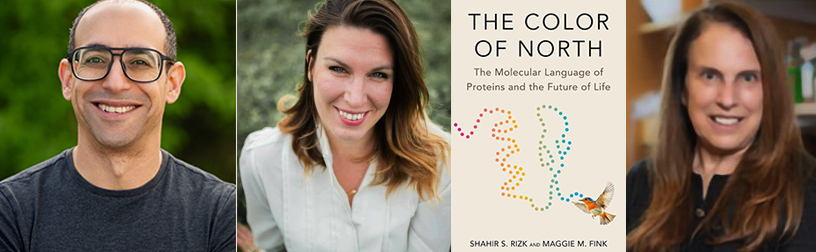
Each fall, a robin begins the long trek north from Gibraltar to her summer home in Central Europe. Nestled deep in her optic nerve, a tiny protein turns a lone electron into a compass, allowing her to see north in colors we can only dream of perceiving.
Taking us beyond the confines of our own experiences, The Color of North traverses the kingdom of life to uncover the myriad ways that proteins shape us and all organisms on the planet. Inside every cell, a tight-knit community of millions of proteins skillfully contorts into unique shapes to give fireflies their ghostly glow, enable the octopus to see predators with its skin, and make humans fall in love. Collectively, proteins orchestrate the intricate relationships within ecosystems and forge the trajectory of life. And yet, nature has exploited just a fraction of their immense potential. Shahir S. Rizk and Maggie M. Fink show how breathtaking advances in protein engineering are expanding on nature’s repertoire, introducing proteins that can detect environmental pollutants, capture carbon dioxide from the atmosphere, and treat diseases from cancer to COVID-19.
Weaving together themes of memory, migration, and family with cutting-edge research, The Color of North unveils a molecular world in which proteins are the pulsing heart of life. Ultimately, we gain a new appreciation for our intimate connections to the world around us and a deeper understanding of ourselves.
Shahir S. Rizk is Associate Professor of Biochemistry at Indiana University South Bend and the Indiana University School of Medicine. The recipient of the Cottrell Scholar Award, he is an illustrator and poet whose work has appeared in Acorn, Modern Haiku, and Twyckenham Notes. He cohosts the podcast Rust Belt Science.
Maggie M. Fink is Adjunct Professor at Indiana University South Bend and a postdoctoral researcher at the University of Notre Dame, where she divides her time between science communication and studying bacterial genetics. She is an artist and poet whose work has appeared in Landlocked Lyres and been featured in exhibits at the University of Notre Dame. She cohosts the podcast Rust Belt Science.
Pamela Silver is the Adams Professor of Biochemistry and Systems Biology at Harvard Medical School and a founding member of the Wyss Institute for Biologically Inspired Engineering at Harvard University where she runs the Sustainability Futures Initiative. Silver grew up California, received her BS at UC Santa Cruz and her PhD at the UCLA and followed with Postdoctoral work at Harvard University where she was an American Cancer Society Fellow. She was an Assistant Professor at Princeton prior to the Dana Farber Cancer Institute at Harvard Medical School where she was a Professor in the Dept of Biological Chemistry and Molecular Pharmacology at Harvard Medical School. She was one of the first members of the new Dept of Systems Biology at Harvard Medical School where her laboratory now resides. She is an elected member of the American Academy of Arts and Sciences and the National Academy of Sciences and the past Daniel’s Fellow of the Radcliffe Institute for Advanced Study. She has received the Distinguished Alumni Award from UCSC, the Innovative Technology Prize (BIO), the FastCompany Innovation Award and the Joseph Henry Lecture of the Philosophical Society. She has been recognized as one of the top Global Synthetic Biology Influencers and her work named as one of the top 10 Breakthroughs by the World Economic Forum. She is the founder of several companies and served as a member of the National Science Advisory Board for Biosecurity (NSABB).
Organization/Sponsor: Harvard Book Store, Harvard Division of Science, Harvard Library, and Cambridge Public Library.
For more information and videos of Harvard Science Book Talks, see https://science.fas.harvard.edu/book-talks.
Contact Info: science_lectures@fas.harvard.edu